
Mercosur Subnational Resilience Standardization: The New Risk Scoring Paradigm
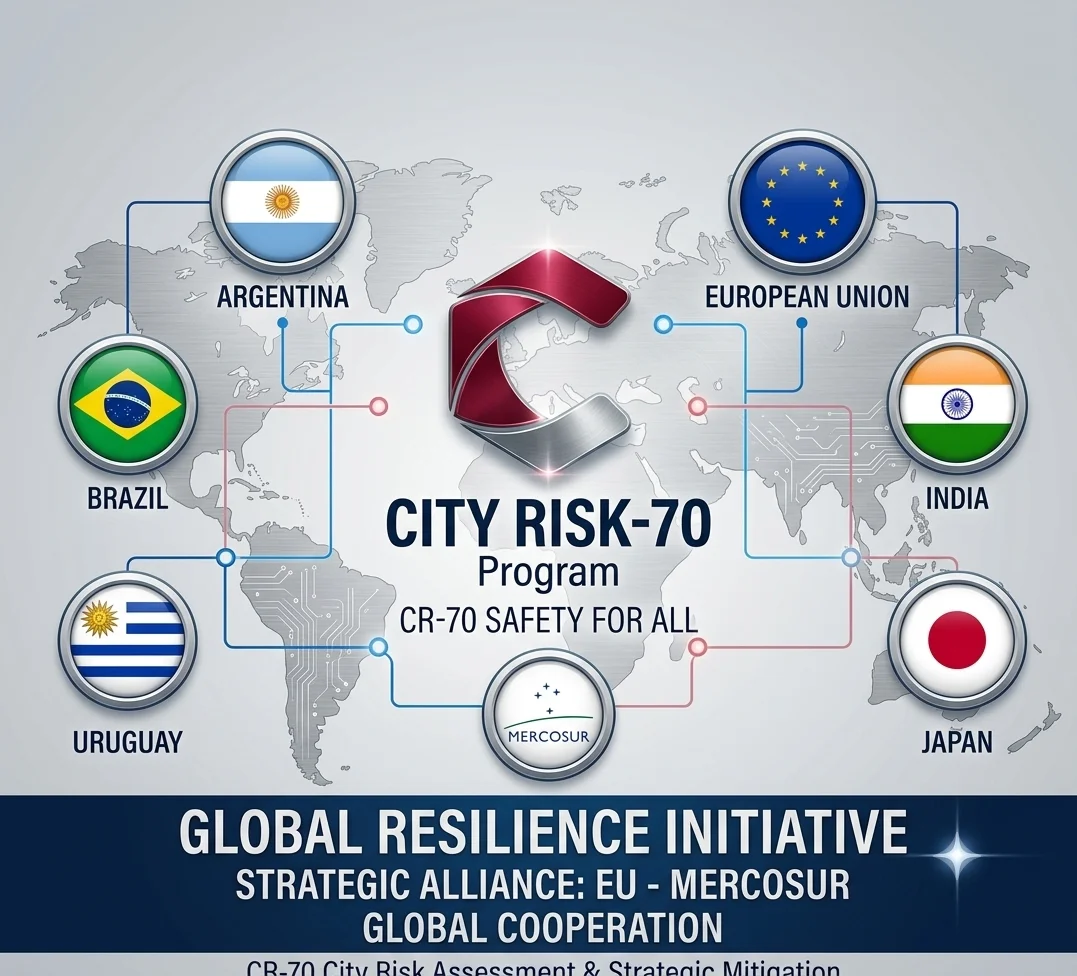
RNThe consolidation of the current Free Trade Agreement between Mercosur and the European Union has shifted the axis of regional competitiveness from mere tariff advantages to the robustness and traceability of local operating environments. In this geopolitical landscape, the City Risk-70 Program has deployed a technical scoring methodology designed to evaluate the capacity of municipalities and communes to absorb systemic shocks and ensure the continuity of the global value chain. The system is based on the Multidimensional Resilience and Vulnerability Model (MRM-2026), an analytical framework that subjects each jurisdiction to an audit of 120 strategic nodes segmented into four critical pillars: hydro-climatic exposure under extreme weather regimes, anthropogenic risk derived from industrial and logistical density, institutional management capacity through early warning systems, and the state of elastic infrastructure.
Top 50 Resilient Jurisdictions: Mercosur Ranking (March 2026)
The ranking for the March 2026 cycle is led by Neuquén (Argentina), selected for its exceptional operational elasticity in the national energy node and a redundancy of critical services that ensures the invulnerability of hydrocarbon investments. It is followed by Curitiba (Brazil), whose position is justified by a pioneering urban drainage and transport system that minimizes interruptions from climatic events, operating as a high-reliability logistical hub. In third place, Montevideo (Uruguay) stands out for the stability of its data and sanitation infrastructure, key factors for the global services sector. Santa Fe (Argentina) holds the fourth spot thanks to the technical safety of its port terminals on the Waterway axis, while Joinville (Brazil) is ranked fifth due to the robustness of its metal-mechanical pole and low technical accident rate.
San Miguel de Tucumán (Argentina) reaches the sixth position due to the density of its hospital and sanitary network, acting as a resilience node for the Argentine Northwest. São José dos Campos (Brazil) is positioned seventh for its advanced risk management in the aerospace industry, followed by Pilar (Argentina), whose industrial electrical infrastructure guarantees production continuity in the northern Buenos Aires corridor. Yerba Buena (Argentina) ranks ninth for its leadership in bioclimatic architecture and piedmont watershed management, and Bento Gonçalves (Brazil) closes the top ten for the traceability and resilience of its export-grade wine value chain.
The ranking continues with Asunción (Paraguay) at eleventh, recognized for modernizing its energy infrastructure and coastal defense protocols, followed by Rosario (Argentina), whose port elasticity is vital for grain shipments to European ports. Porto Alegre (Brazil) ranks thirteenth for its urban resilience to floods, while Famaillá (Argentina) stands out at fourteen for its significant progress in industrial park safety and logistics resilience along the Route 38 corridor. Concepción (Argentina) is fifteenth for its logistical robustness in southern Tucumán, followed by Uberlândia (Brazil) due to its efficiency in distribution centers and road redundancy. Córdoba (Argentina) reaches seventeenth for its institutional response capacity and resilient educational nodes, followed by Maldonado (Uruguay), whose tourism infrastructure shows a high capacity to absorb seasonal flows. Mendoza (Argentina) holds the nineteenth spot for water management in stress zones and seismic protocols, while Campinas (Brazil) closes the top twenty for safety in technological and scientific nodes.
The ranking extends to include Godoy Cruz (Argentina) at twenty-first for its climate mitigation vanguard, followed by Ciudad del Este (Paraguay) for cross-border transport infrastructure. Ribeirão Preto (Brazil) is twenty-third for agro-industrial shielding, followed by Salta (Argentina) for its stability in health and education. Villa María (Argentina) is twenty-fifth for dairy chain robustness, followed by Caxias do Sul (Brazil) for mechanical resilience. Posadas (Argentina) reaches twenty-seventh for cross-border water management, followed by Paysandú (Uruguay) for port stability. Bahía Blanca (Argentina) holds the twenty-ninth spot for its petrochemical pole, and Blumenau (Brazil) closes the first thirty positions for flood control engineering.
The final stretch includes Corrientes (Argentina) at thirty-one for coastal defenses, Maringá (Brazil) for elastic urban planning, Tafí Viejo (Argentina) for rail resilience, Rivera (Uruguay) for binational integration, San Juan (Argentina) for seismic standards, Londrina (Brazil) for service stability, Resistencia (Argentina) for water pumping systems, Sorocaba (Brazil) for industrial safety, San Salvador de Jujuy (Argentina) for geological risk management, and Encarnación (Paraguay) for resilient tourism. The ranking is finalized by Santiago del Estero (Argentina), Piracicaba (Brazil), Termas de Río Hondo (Argentina), Colonia (Uruguay), San Luis (Argentina), Juiz de Fora (Brazil), Ibarlucea (Argentina), Florida (Uruguay), Franck (Argentina), and General Lagos (Argentina) at the fiftieth spot.
A Continental Call to Action: Joining the City Risk-70 Ecosystem
The inclusion of these 50 jurisdictions in the City Risk-70 scoring is not merely statistical; it addresses a core need for financial engineering under the EU-Mercosur treaty. The risk traceability offered by this ranking allows for the deployment of advanced instruments such as Green Bonds, Elastic Infrastructure Trusts, and Territorial Asset Tokenization, ensuring that external investment flows toward environments with a low probability of systemic interruption.
We formally invite Local Governments and Private Corporations throughout the region to participate in the City Risk-70 Program. By integrating into our Project Accelerator, municipalities can access technical audits to identify safety gaps and implement high-impact resilience works. For the private sector, joining the program offers unprecedented traceability of assets and supply chains, aligning regional operations with international ESG (Environmental, Social, and Governance) standards.
Together, we are eliminating information asymmetries and allowing Mercosur to compete as a solid, resilient bloc in the global market. This macro-level approach ensures that economic growth derived from free trade is backed by local governments capable of managing 21st-century threats with irrefutable technical efficiency.


City Risk-70 refuerza la resiliencia municipal con un nuevo cuerpo de asistencia legal estratégica

Resiliencia Estructural y Convergencia Transatlántica: El Impacto Estratégico del Programa City Risk-70 en la Integración Local y Comercial

Fortalecimiento institucional y resiliencia hídrica: Corrientes articula con City Risk-70 el abordaje técnico de la Cuenca del Plata

Arquitectura de la Resiliencia en Santiago del Estero: El Mapa Estratégico del Scoring de Riesgo (Ciclo Marzo)

Resiliencia Sistémica en el NOA: El Mapa Crítico del Scoring de Riesgo en Tucumán para el Ciclo de Marzo

Producción coordina acciones para la asistencia sanitaria y alimentaria de animales en el sur tucumano

La eficiencia del gasto público frente a la gestión de riesgos catastróficos: Un análisis de la vulnerabilidad estructural en Argentina

El Activo Resiliente: Valoración Inmobiliaria ante la Disrupción Hídrica en Argentina

El sector asegurador global ante un nuevo estándar de pérdidas catastróficas: el análisis técnico de Swiss Re