

Systemic Risk Management and Infrastructure Structuring: City Risk-70 Deploys a New Mitigation Model for Governments and Corporations
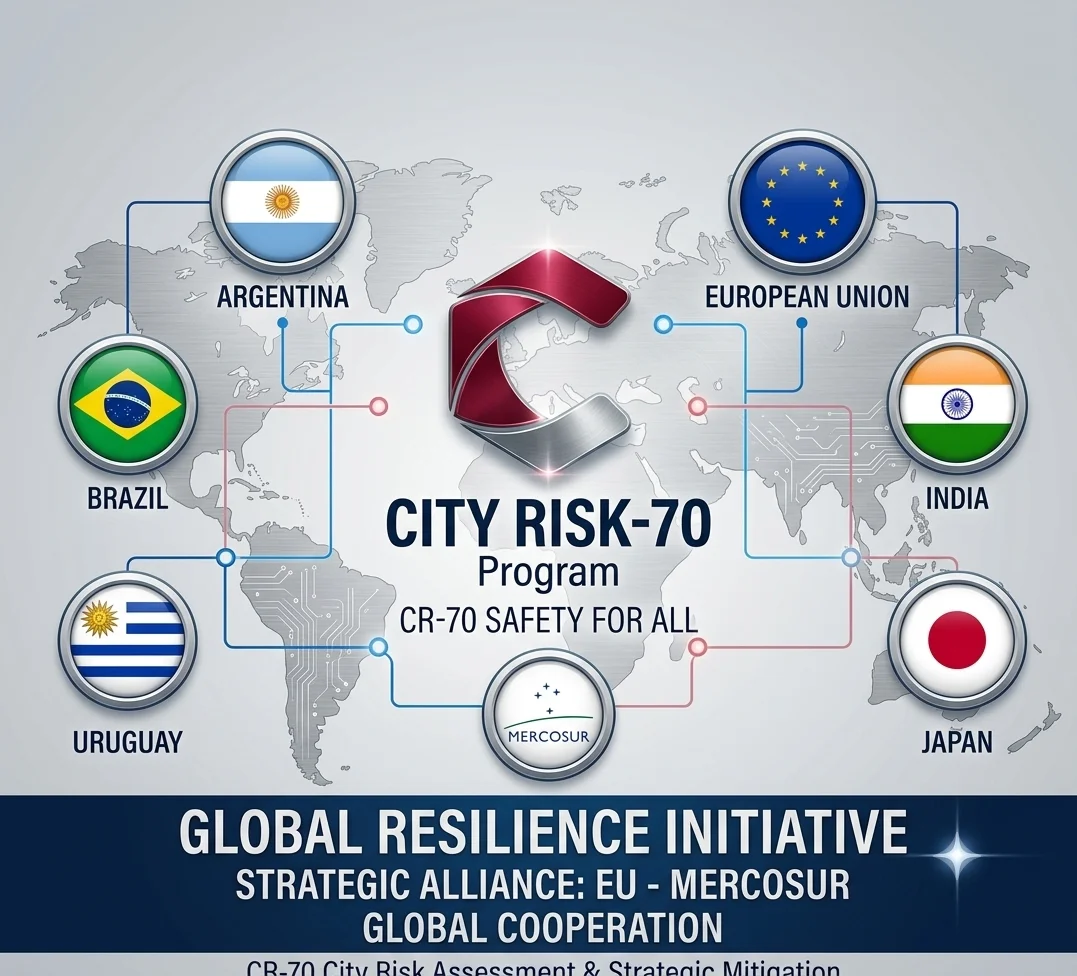
RNThe acceleration of climate change, the increasing instability of global supply chains, and the demand for adaptive urban infrastructure require management tools that surpass traditional contingency responses. In this scenario, the City Risk-70 Program has consolidated its position in the international market by formally extending its technical assistance and strategic auditing alternatives to local governments and corporations in Ibero-America and Germany. Through an approach based on high-precision data and algorithmic governance, this initiative establishes itself as a bridge of operational and financial resilience that directly links the Euro-Mercosur axis during a period of global economic reconfiguration.
​The assistance provided by City Risk-70 is based on the multidimensional evaluation of 70 critical vectors that determine the vulnerability of a territory or a business unit to climate, hydrometeorological, and systemic disruptions. For public administrations, the benefits of this methodology translate into an optimization of public spending, the technical design of institutional continuity plans, and the creation of solid local regulations aimed at climate adaptation and asset security. For its part, the corporate sector gains preventive shielding for its value chain, mitigation of financial impacts from catastrophic events, and direct alignment with international socio-environmental compliance and ESG standards. The advanced use of technologies such as two-dimensional hydrodynamic modeling and the design of digital twins allows for the projection of extreme stress scenarios with statistical rigor, providing decision-makers with a predictive compass of invaluable worth in contexts of high uncertainty.
​The main difference between City Risk-70 and the various international programs offered by multilateral organizations lies in its operational architecture and its agility of implementation. While large credit lines and traditional global development programs are usually subject to extensive bureaucratic timeframes, abstract macroeconomic conditionalities, and generalized diagnoses, City Risk-70 operates under a logic of customized risk engineering applied directly to the territory or the firm. The program does not limit itself to suggesting global sustainability guidelines; it executes an immediate systemic diagnosis through its self-assessment test and phased structuring, allowing risk management to become a short-term market competitive advantage. This methodological flexibility facilitates public-private synergy, transforming public lands, critical infrastructure, and investment portfolios into resilient assets with a uniform technical standard recognized in both Europe and South America.
​The decision to expand the program's capabilities to the European continent responds to a strategic reading of the contemporary international commercial landscape. Regarding this deployment, Peter Sundheimer, director of City Risk-70, highlights that the projection into Europe, and especially the focus on Germany, stems from a need for technical and financial convergence within the new context of market integration. As the director explains, the goal is not only to strengthen the program's analytical platform but also to structure a symmetrical service capable of responding to the demands of companies and local governments in both Mercosur and the European Union within the framework of their free trade agreement. Sundheimer points out that the entry into force of the bilateral agreement imposes unprecedented demands regarding public procurement, the standardization of sustainability criteria, and the legal certainty of investments—areas where technical asymmetries typically penalize local administrations. By unifying systemic risk criteria under a single transatlantic standard, the program functions as a catalyst that brings predictability and technical robustness to commercial operations and critical infrastructure projects, minimizing regulatory barriers and facilitating the secure flow of investments between both economic blocs.
​For further information regarding audit frameworks, to access self-assessment tools, or to coordinate a technical assistance session, public administrations and corporate entities can contact the program's administration via its official email at [email protected] or by visiting the institutional platform at www.cr70.org.


Fortalecimiento resiliente: El programa CR-70 y la transformación de la gestión del riesgo de desastres en los municipios argentinos

City Risk-70 Despliega un Nuevo Modelo de Mitigación para Gobiernos y Empresas en Iberoamérica y Alemania

Resiliencia de escala subnacional: el imperativo estructural detrás del despliegue regional del Programa City Risk-70

Gobernanza Algorítmica con Rostro Humano: La Inteligencia Artificial como Acelerador del Desarrollo Municipal

INFRAESTRUCTURA RESILIENTE: EL MODELO DE ARTICULACIÓN PÚBLICO-PRIVADA QUE RECONFIGURA EL DESARROLLO URBANO

El Quiebre de la Previsibilidad: El Límite de los Modelos Actuariales ante el Clima Extremo

El laberinto de la opacidad: Fondos paralelos en el sector financiero y la elusión sistemática de obligaciones alimentarias

El laberinto de los embargos preventivos de AGIP: cuando la falta de notificación asfixia al contribuyente